
The four strategic change choices of AI
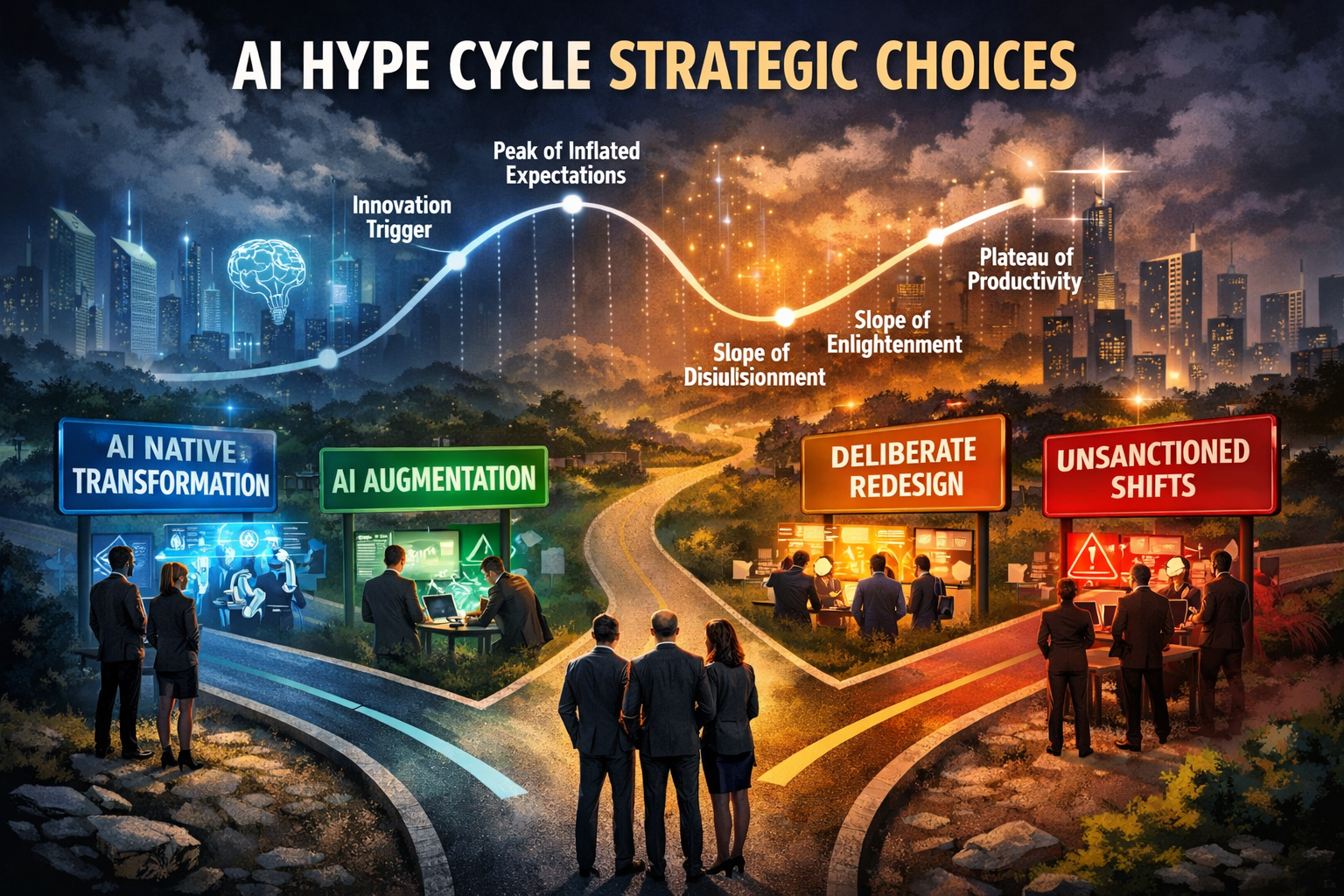
I think we are in the midst of a hype cycle where the executives chose ‘me too ism’ as their change strategy.
2015 – 2020 was the Agile transformation hype cycle – ‘we’re all going Agile – roll out the Spotify model’.
2017 – 2021 saw the Digital transformation hype cycle – ‘we’re going to digitise our business, let’s hire a Chief Digital Officer’.
And now based on the noise it seems like we are in the midst of an AI Hype cycle.
Hype cycles are associated with Gartner’s technology predictions. They consist of five stages:
Innovation Trigger: Becoming aware of the technology and first projects that arouse considerable public interest.
Peak of Inflated Expectations: The technology is at the summit of attention. Unrealistic and enthusiastic expectations are published and discussed.
Trough of Disillusionment: As the technology cannot meet the expectations built up previously, the attention of disappointed enthusiasts and media representatives sinks to the low point.
Slope of Enlightenment: The new technology is considered realistically with its strengths and weaknesses in this phase.
Plateau of Productivity: The new possibilities offered by the technology are accepted as advantages and business processes are developed.
And what often plays out is a concept known as ‘mimetic isomorphism’ – where companies when facing disruptive uncertainty copy others who seem to be successful. Which is a shame – it seems that the dynamics of the hype cycle short-circuit an ability to recognise that in the presence of any disruption you have choice.
I wrote about this in 2020 – and suggested that the pandemic offered a stimulus for four types of change strategies to embark on – reinvention, renewal, reintegration and revolt. It’s why my spidey senses are on high alert, I have seen this before.
And I think that today, in the midst of the noise, and clamour of AI-induced razzle dazzle, as an executive team you also have a set of strategic choices. For you see, AI is not one thing. It is a disruptive technology that will generate great opportunities and great losses and some modest successes along the way. It is your executive team’s ability to navigate the choices that will determine where you end up on this pathway of outcomes.
Four strategic change choices (whether you name them or not)
If you strip away the hype, most organisations have the opportunity to chose four change designs.
AI native transformation
You hear your executives declare ’We’re all in!’. It’s the most common conversation – akin to the Agile Transformation (‘We’re going Agile’) where AI is introduced to transform the entire organisation everywhere, all at once. There’s a flurry of recruiting of talent, declarations to the market, and the procurement of technology. The good thing is everybody in the organisation, for once, is crystal clear of intent and direction. There are some very sexy opportunities for the ambitious and those who love learning.
As with all transformations, it is highly risky from a ROI perspective. The loud enthusiasm can mask bad design and when momentum falters people get nervous. AI product owners start looking to jump ship.
It is of course, not all about the technology – and to be successful it needs to be preceded by a new target operating model. Leaders need to role model test and learn (which is often deeply confronting. They need to showcase strong change commitment and resilience and lean heavily into self-compassion to buffer the discomfort of a transformation.
AI Augmentation
You hear your executives acknowledge the disruptive technology with calm commitments of ‘we’ll take it slowly and cautiously’. Their organisations keep their existing structures, roles, and processes, and selectively layer AI into them — Copilot in the workflow, a research assistant for the analysts, transcription for the meetings.
The good thing is this is easier to manage from a change adoption perspective, it’s less threatening and builds more time for people to experiment and come up with new ways of doing things.
The more challenging aspect of this approach is like the digital transformation before, where if the operating model and processes are not sound to start with, you have digital crap, with AI you have AI augmented slop.
Like the choice to transform the leader needs to be big on role modelling and experimenting – but this strategic change choice hangs heavily on the change communication and engagement for success.
Deliberate redesign
Here your executives have noted the disrupted technology and embraced a bit of Churchill (ala never let a crisis go to waste). ‘Seize the day!’ they say and use AI as the occasion to rethink how work is structured without abandoning who they are. Job families are reshaped, processes rebuilt around what AI does well. The organisations’ identity and purpose remain continuous.
This from my view shapes up as the smart strategic choice – it offers limited disruption for customers and provides a strong opportunity for renewal and growth. That said, it likely involves job loss, and redesign is always difficult for entrenched processes.
The leaders change efforts involve change design, and ideally a generous dose of co-creation. Much of their time will be spent on boundary maintenance – navigating the guardrails required, the ethical decisions to be made. They’ll also be needing to manage survivor syndrome as the job loss will be jarring.
Unsanctioned shifts
Lastly, the decision to ignore AI and not make decisions is a strategic choice. Maybe not said out loud, but what’s going on with your executives represents ‘Not listening, not watching, too hard!’. And it is playing out in organisations all over the world. Make no mistake though, it has consequences – namely of untamed change and unsanctioned shifts.
This is a state of change driven by revolt: employees pushing back on the use of AI (surveillance, job insecurity), employees pushing back on the lack of AI and using unsanctioned tools, customers pushing back on AI mediated service. This revolt is multi-directional, and that's what makes it so hard to read.
It is difficult to point out a positive with this strategic change choice – but for the executives who wish to look, they will see that the workarounds reveal the real operating model. There is an abundance of free diagnostic data for leaders willing to engage.
But of course, huge risks are introduced here and difficult to manage or mitigate as so much is unspoken.
The executive who wants to lead change in this environment has the opportunity to embark on listening tours, collecting signals and developing a business case for one of the three aforementioned strategic change choices.
A quick reality check
Before you go too far down the AI path, it’s worth asking a few uncomfortable questions:
What are we actually trying to improve or change?
Which of these pathways are we choosing?
What are we deliberately not doing?
Do our people understand the difference?
Because right now, a lot of organisations are effectively saying:
‘We’re transforming’ … while asking their teams to just ‘have a play with CoPilot’.
Deja Vue: The human bit hasn’t gone anywhere.
Like the situation back in 2020, there are humans at the core of the success of these strategic change choices. Fear remains a primary experience – while back in 2020 it was more of the complex pressures of potential job loss, loss of autonomy, and health anxiety, today If anything, it’s intensified – a version of compound trauma. Having survived the pandemic and associated workplace change, they are now subject to an overwhelming volume of change AND fear and concern about a technology that is moving exponentially fast and thinking on their behalf.
This means you’ve got:
people fretting about relevance.
others over-indexing on AI because they think they should.
some who are genuinely curious and moving fast.
some who a quietly confident after spending 12 months at night and the weekend building their agent workflows and learning to code.
and a decent chunk who are just tired, oh so tired.
And all of that shows up in how they engage with AI.
The leadership work (the bit that actually matters)
This isn’t about picking the ‘right’ pathway, it’s about being deliberate.
Because each path asks something different of you:
different pacing
different investment
different communication
different leadership behaviour
From my perspective, right now the biggest risk isn’t AI. It’s leaders skipping the thinking and going straight to the doing, or worse the ‘me tooism’. Getting caught up in the technology and forgetting that those shiny returns are dependent on good design and savvy management of people.
If you are not making a strategic change choice, you are defaulting to one. That can be a very expensive choice to make.