

“Traveller, there is no path. The path is made by walking.”
You've almost certainly seen this image. It does the rounds every few months.
See content credentials
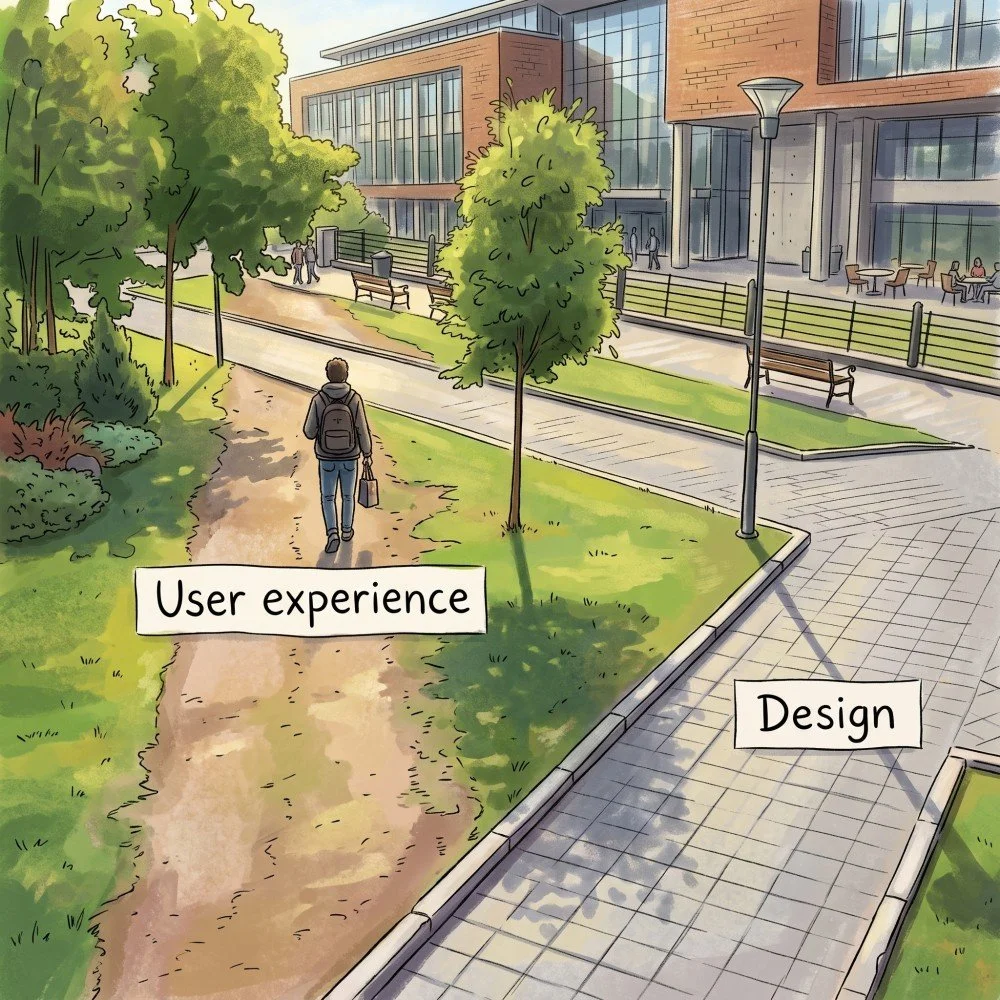
A neat paved path, carefully curved, labelled Design. Right beside it, a worn dirt track cutting straight through the grass, labelled User experience. And a student with a backpack, walking the dirt.
Nobody designed that track. Everybody uses it.
Now look at your last system go-live. The shared spreadsheet nobody was meant to keep. The WhatsApp group that "isn't an official channel." The manager who still approves things by email.
What if those aren't compliance failures? What if they're desire paths?
The concept – the routes people actually walk
Landscape architects and urban planners call them desire paths or desire lines: the informal tracks people wear into the ground when the official route doesn't match where they're actually trying to go. The Germans have a wonderfully blunt word for them, Trampelpfad: trample path.
Physicist Dirk Helbing, who studied how these paths form, found a striking threshold. People start cutting their own route when the official one is roughly 20 to 30 per cent longer.
Planners respond in two ways. Some fight the path, with chains, plantings and raised lawns that make the shortcut harder. Others wait. Michigan State University famously left areas unpaved, let students wear in their own routes, and then paved what emerged.
Here's the bridge. Every change initiative lays down official paths: processes, systems, approval flows. And every workforce, within weeks, starts wearing in its own. Most change programs treat those tracks as non-compliance to be shut down. But a desire path is the most honest user research you'll ever get. It shows you, in mud, where the design was 30 per cent too long.
Connecting the dots
Here's a composite drawn from health sector rollouts.
A health service introduced a new rostering system. Within a month, nurses on several wards were running a shared spreadsheet alongside it. The project team flagged it as a data risk and asked the change lead to shut it down. She asked to see it first. In her post-go-live review, she sat with two nurse unit managers and walked through what the spreadsheet actually did.
The answer was simple. The new system routed every shift swap through a manager for approval. The spreadsheet let nurses see who was available and agree a swap between themselves first. The official path took two days. The desire path took ten minutes.
The team configured a peer-visible swap request with a manager notification to fix the issue and the the spreadsheet quietly died on its own.
The application: How to read the paths people walk
1) Map the trampled grass
How it works: Workarounds cluster where the design is most out of step with the work. Find them before you fight them.
Practical example: During hypercare, ask every team one question: "What's the shortcut you're using that we didn't design?" Collect the spreadsheets, side channels and email approvals.
Why it works: It turns hidden friction into a visible backlog, early, while fixes are still cheap.
Watch for: Framing it as an audit. If people think you're hunting rule-breakers, the paths go underground. Make it an amnesty.
2) Pave some paths
How it works: For lower-risk processes, release the minimum design, watch where people walk, then formalise what emerges.
Practical example: Launch a new intake process with only the essential steps for six weeks. Then run a short review to decide which of the routes people created become the official way.
Why it works: People adopt what they helped shape. The design fits because it came from the work.
Watch for: Leaving it unfinished forever. "Wait and see" needs a date when you stop waiting.
3) Put up chains only where it matters
How it works: Some shortcuts are genuinely dangerous: privacy, safety, legal exposure. Those need a barrier, and a better route.
Practical example: Where a workaround breaches policy, explain why the line exists and offer a faster compliant option in the same breath.
Why it works: People respect a boundary when they can see what it protects and still get where they're going.
Watch for: Barriers with no alternative. Put a fence across a desire path and people simply climb the fence.
The caveat: Not every shortcut is wisdom
The goal isn't to pave every path. It's to read them. A desire path shows you what's convenient, not always what's right. One university found a shortcut had been worn straight across Indigenous effigy mounds. Convenient for walkers. Deeply damaging to something that mattered to others.
The same is true at work. Some workarounds protect the people walking them at someone else's expense. Read the path, then ask who it costs.
Over to you
What workaround in your current change has everyone been trying to shut down? And what might it be telling you about where your design is 30 per cent too long?